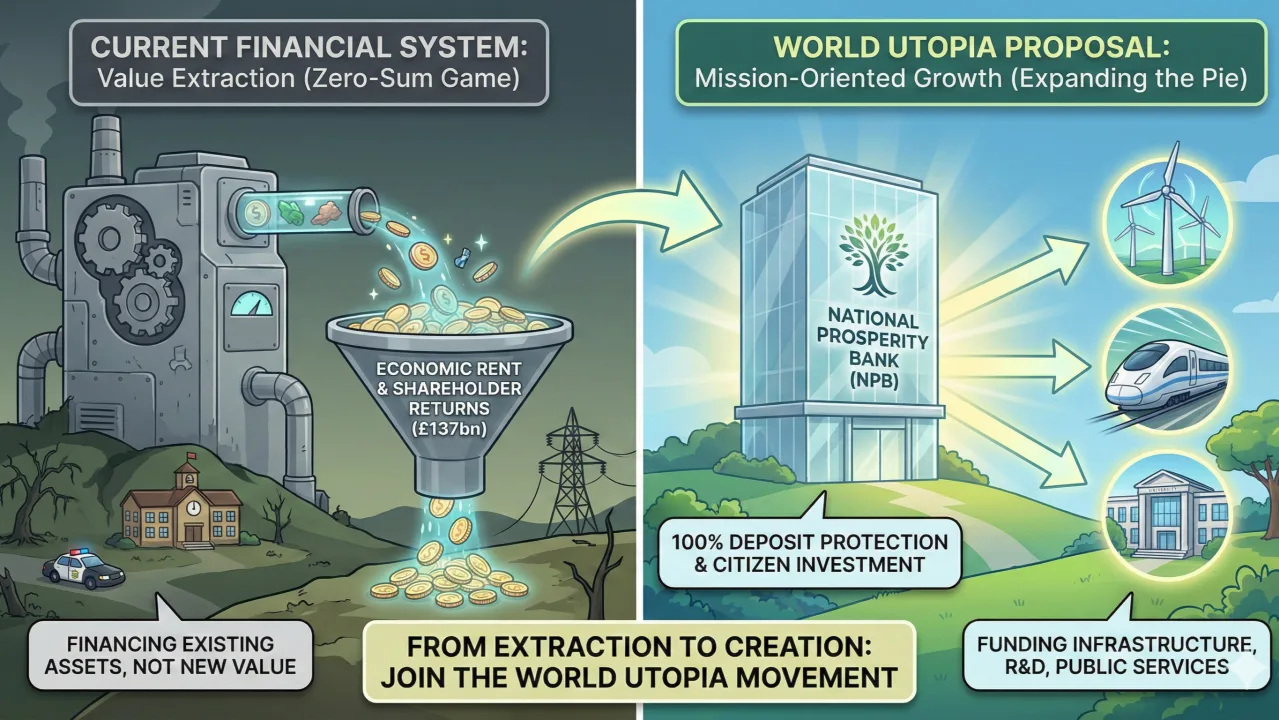
We are told the financial system is the engine of our economy. But if the engine is consuming more fuel than it provides in power, we have a problem.
The current financial model is not just inefficient; it is actively extracting value from the real economy. It is time to move from a system of rent extraction to one of mission-oriented growth. Here is the evidence, the numbers, and the World Utopia (WU) proposal for a new banking paradigm.
1. The zero-sum game: extraction vs. creation
Leading economist Mariana Mazzucato argues that modern finance has confused value extraction with value creation. A significant portion of financial activity is not funding new businesses or infrastructure but is instead trading existing assets—buying and selling what already exists to generate fees (Mazzucato, 2018).
This aligns with Hyman Minsky’s “Financial Instability Hypothesis”, which warns that during stable periods, the financial sector moves from “hedge finance” (safe) to “speculative” and finally “Ponzi finance”, relying on asset price inflation rather than productive income (Minsky, 1992).
Is it a zero-sum game? Largely, yes. When a bank lends money for a mortgage on an existing house, or an asset manager trades a secondary share, no new value is created. Money simply moves from one pocket to another, with the financial intermediary taking a cut (economic rent). This “financialisation” siphons capital away from the real economy—innovation, manufacturing, and green infrastructure—where it is desperately needed (Ryan-Collins, 2018).
2. The cost: £137bn extracted vs. public needs
The numbers are stark. In the UK, research indicates that over 80% of bank lending goes into the FIRE sector (Finance, Insurance, and Real Estate), rather than supporting non-financial firms (Ryan-Collins, 2018).
Even more damning is where the profits go. In 2022/23, FTSE 100 companies—dominated by financials and rent-seeking sectors—were primed to return approximately £137.2 billion to shareholders via dividends and buybacks (Mazzucato, 2024). This is money extracted from the corporate ecosystem rather than reinvested in wages, R&D, or growth.
Compare this £137bn of extracted value to our critical public spending:
- Policing
- £19.5bn
- The total funding for the entire policing system in England and Wales for 2025–26 (Home Office, 2024).
- Schools
- ~£60bn
- The core schools budget. We could double the education budget with less than half of what is extracted annually in shareholder returns.
- Energy transition
- up to £40bn
- The annual investment the UK needs to upgrade the energy grid for a net-zero future (National Energy System Operator, 2025). The capital exists; it is just being allocated to rent-seeking rather than national renewal.
3. The solution: the National Prosperity Bank
World Utopia proposes a radical yet practical alternative: a pseudo-government bank—let’s call it the National Prosperity Bank (NPB).
The “killer” feature: 100% deposit protection
Currently, the Financial Services Compensation Scheme (FSCS) only protects deposits up to £85,000 (rising to £120,000). The NPB would offer a 100% state guarantee on all deposits, similar to NS&I.
Why this works: during times of stress, capital flies to safety. A bank with a 100% guarantee would attract massive liquidity from risk-averse savers and high-net-worth individuals, instantly creating a colossal pool of capital (Federal Reserve, 2025).
The “citizen investor” model
Instead of using these deposits to speculate on derivatives, the NPB would invest in long-term national missions: green energy grids, high-speed rail, and affordable housing.
- Guaranteed + variable rate: depositors get a competitive guaranteed base rate plus a variable return linked to the success of these national projects.
- Choice and agency: citizens can allocate a portion of their savings to specific “Mission Funds” (e.g. “The Clean Power Fund” or “The NHS Tech Fund”). If a project you back succeeds, you share in the upside.
- Personalised data: customers could opt in to share government data (tax, benefits, DVLA) to receive hyper-personalised financial services, automated tax returns, and instant credit decisions, cutting out administrative waste.
The verdict: expanding the pie
This is not the zero-sum game of the stock market. By directing savings into new infrastructure and technology, we create new value.
- We stop funding asset price bubbles.
- We start funding the police, education, and energy transition through smart investment returns, reducing the tax burden.
- We turn every saver into a stakeholder in the nation’s success.
The money is there. The ideas are here. It is time to build.
References
- Federal Reserve (2025) Central Bank Access and Flight to Safety. Washington D.C.: Federal Reserve Board.
- Home Office (2024) Provisional Police Grant Report (England and Wales) 2025-26. London: HM Government.
- Mazzucato, M. (2018) The Value of Everything: Making and Taking in the Global Economy. London: Allen Lane.
- Mazzucato, M. (2024) Written evidence submitted to UK Parliament Committees (IGR0105). London: UK Parliament.
- Minsky, H.P. (1992) ‘The Financial Instability Hypothesis’, The Jerome Levy Economics Institute Working Paper No. 74.
- National Energy System Operator (2025) Investment unlocked: transforming grid connections. London: NESO.
- Ryan-Collins, J. (2018) Why Strategic Investment Banks? London: UCL Institute for Innovation and Public Purpose.